On 10 November 2026, TechFlow Post published a Chinese compilation by Luffy of Foresight News of the Western Europe chapter of Chainalysis’s 2026 Global Crypto Adoption Report. The measurement window is July 2025 through June 2026. This is that article’s account, not a later update. Where a data point sits outside the window, the compilation says so.
Scale is not a statement of who owes the customer
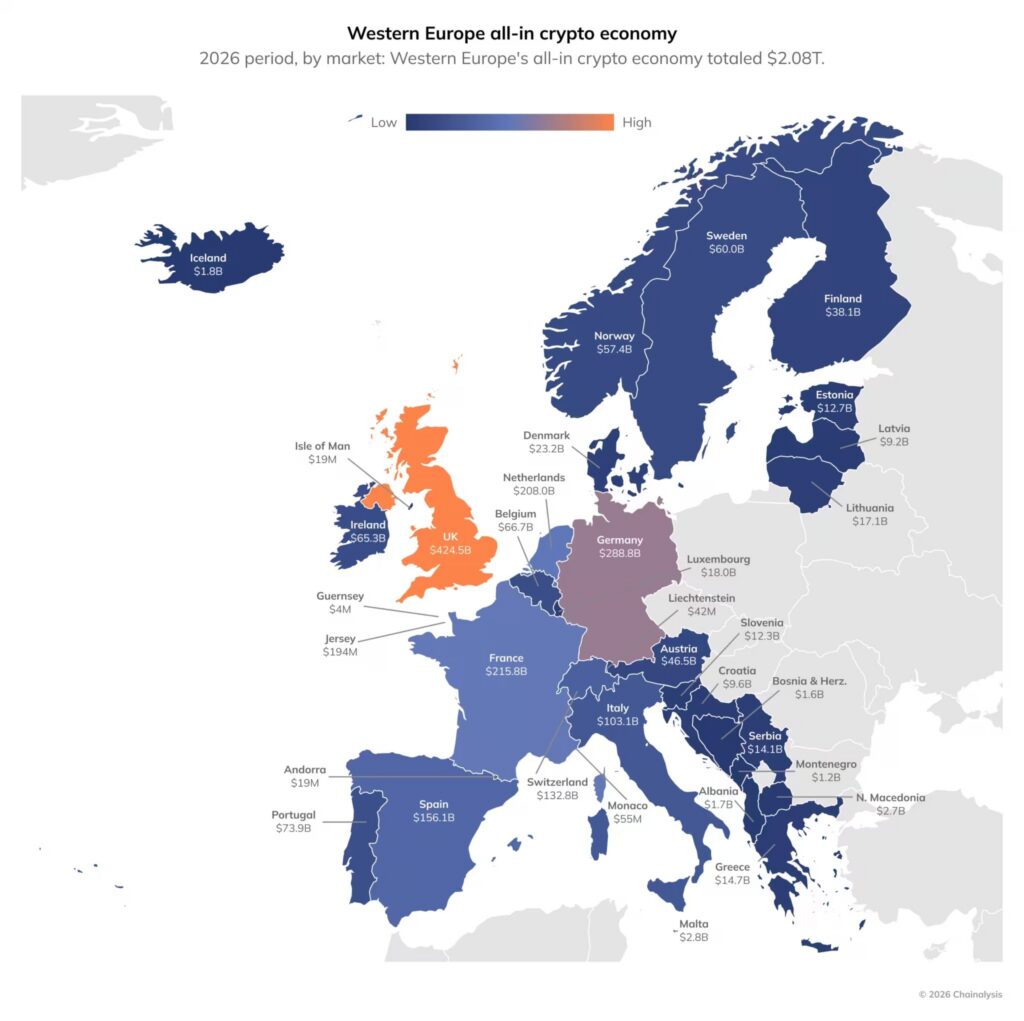
Over that window the compilation puts Western Europe’s crypto economy at $2.08 trillion, second in the world, up 1.2 percent. It says only Sub-Saharan Africa, Latin America, and Western Europe recorded positive growth while the global crypto market was in a downturn, and that the regional expansion occurred in a bear market in which global crypto market capitalization was cut in half.
That $2.08 trillion is the report’s measure of crypto-economy scale. It is not assets under custody, not a reserve total, and not a customer-liability figure.
On-chain visibility and legal obligation are different layers. Value that moves through a centralized exchange leaves the customer facing that exchange. Volume on a decentralized exchange is venue activity, not a custodian’s promise to return funds. A stablecoin in a personal wallet is a token balance the chain can show; any redemption claim runs to the issuer, and any reserve is the issuer’s asset — often including bank deposits that are themselves a bank’s liability. None of the wallet or volume figures below establishes solvency, an audit, or a depositor-style protection.
Six markets, and a split between exchange types
The compilation says activity is concentrated. The United Kingdom remained the largest Western European crypto market at $424.5 billion, about 20 percent of the regional total, but fell 8 percent in the window, mainly because decentralized-exchange volume shrank. The chapter frames the UK, as a long-standing financial centre with developed capital markets and banking, as a natural extension of domestic financial services. That is the report’s characterization, not a finding that bank-style obligations attach to crypto balances.
Germany is listed second at $288.8 billion, with a slight contraction the compilation also ties to lower DEX volume. France is third at $215.8 billion and described as roughly flat. Spain ($156.1 billion) and Switzerland ($132.8 billion) grew, which the compilation attributes to more active centralized-exchange trading. With the Netherlands at $207.8 billion, these six markets accounted for about two-thirds of the Western European total. The compilation does not give the Netherlands its own growth rate in that passage. A later figure, 24.6 percent, is the growth rate of Spain’s own crypto economy, not a rate for the other five.
Where the growth the chapter highlights is centralized-exchange activity, the customer’s immediate counterparty is the exchange. Where the contraction is DEX volume, the chapter is describing a drop in on-chain venue activity. Neither direction says whether customer assets were segregated, what an exchange owed, or whether a license changed the legal claim.
Comments on “maturation” are the speakers’ views, not reserve attestations. Christopher Beck, co-CEO of BS Digital, which the compilation calls a leading European crypto-infrastructure provider, said institutional adoption was accelerating and that crypto assets were slowly moving from an emerging speculative asset class into mainstream financial products. Faustine Fleuret, global head of public affairs at Morpho, described as decentralized credit infrastructure, said people were no longer merely experimenting with crypto but embedding blockchains in mainstream finance, and that banks, asset managers, and fintech companies were coming to see on-chain finance not as a parallel system competing with traditional finance but as a new base layer on which businesses can be built. The compilation does not attach liability schedules or reserve reports to either statement.
The euro’s trading share, and what MiCA does not prove
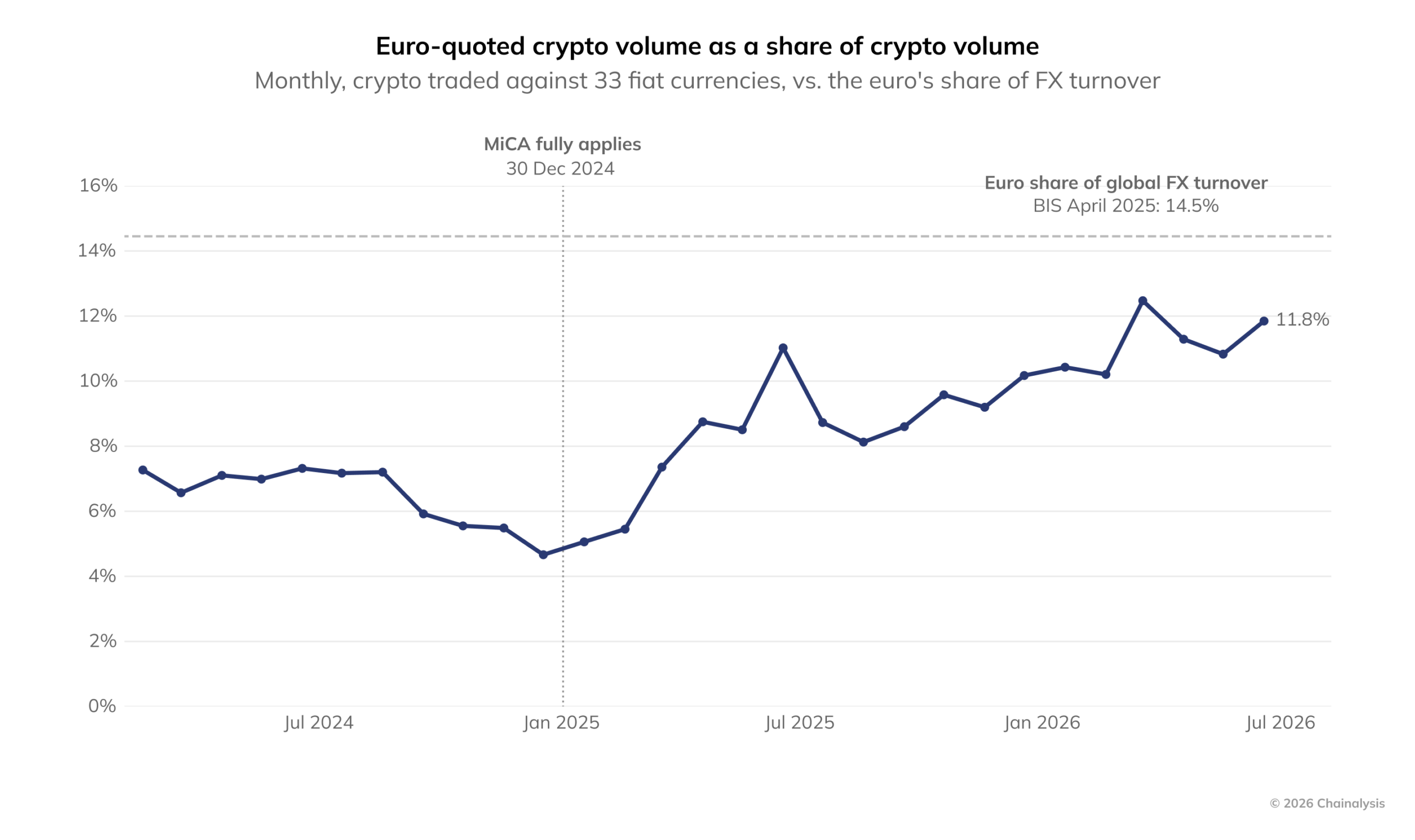
The chapter treats a larger role for the euro as one sign of a more mature market, in line with its role in foreign exchange. Bank for International Settlements figures it cites for April 2025 show the euro on one side of 28.9 percent of global FX turnover. Crypto order books are one-sided pairs — euro versus a token — rather than two-sided FX counts, so the compilation uses half of that share, 14.5 percent, as the reference benchmark. Chainalysis data in the report put the euro’s share of crypto trading, among 33 major fiat currencies, at 11.8 percent at the end of the window, clearly higher than in the past and moving toward that benchmark. The earlier share is not given as a number.
The rise coincided with MiCA coming into force as a single framework for crypto-asset issuers and service providers in the EU. A licensed firm can operate across EU member states instead of seeking a license country by country. The compilation says the data cannot directly prove that MiCA caused the euro’s higher share. Its likely reading is that unified rules steadied the market and that the EU crypto market as a whole expanded.
Laurynas Spangevičius, general manager for Robinhood in Europe, is quoted calling full MiCA implementation the regulatory change with the greatest impact on Europe’s crypto industry: uncertainty replaced by clear rules, after which long-term mainstream investors have the confidence to enter. That is Robinhood’s assessment. Permission to passport a service across the EU is not evidence that client assets are fully reserved, that a firm is solvent, or that customers stand where bank depositors stand.
Stablecoin balances rose faster than the global pace. The claim still sits with the issuer.
The compilation says stablecoins gained weight in Western European residents’ digital-asset holdings, and that personal-wallet stablecoin balances rose in every country it counted. Aggregate personal-wallet stablecoin holdings in the region jumped 131 percent, against 52 percent globally, with Austria and France the most pronounced. That lifted Western Europe’s share of global stablecoin holdings from 3.4 percent to 5.1 percent.
The drivers it names are a desire for more ways to store and transfer value, and MiCA’s explicit entry rules for issuers of euro stablecoins. It says the pace forces a question Europe has to answer: how these digital dollars and digital euros fit inside the existing financial system. A higher on-chain balance shows who can move the token. It does not show who must pay it back, in which currency, or from which assets.
On reserves, the compilation reports a public objection in September 2026. The European Central Bank and EU national central banks opposed a MiCA rule under which an ordinary stablecoin issuer must keep at least 30 percent of reserves in European bank deposits, and a large, significant stablecoin 60 percent. Their stated worry is that a large redemption run could pull bank deposits out suddenly and transmit stress into the banking system. On that description, the holder has a claim on the issuer, and part of the issuer’s reserved assets would be claims on banks. The percentages are a required location and mix. The compilation does not present them as proof that assets equal liabilities, as an audit opinion, or as a statement that token holders would be paid as, or ahead of, bank depositors. It does not report whether the rule was later changed.
Firms are also quoted on commercial uses, which should be kept separate from the holding data. Jan-Oliver Sell, CEO of Qivalis, identified as an alliance-backed, MiCA-compliant stablecoin project, said compliant euro stablecoins already had clear uses: on-chain cash settlement for tokenized assets, and conditional programmable payments between companies, such as payment against delivery. A spokesperson for Spain’s CaixaBank said moving into this business was also about Europe avoiding complete reliance on dollar stablecoins. The compilation gives no volumes, reserve reports, or liability figures with either comment. Its own summary is that a euro stablecoin could become part of Europe’s digital financial infrastructure, while regulators and banks continue to weigh risks to financial stability and monetary sovereignty.
Bond spreads, and euro-priced bitcoin and tokenized gold
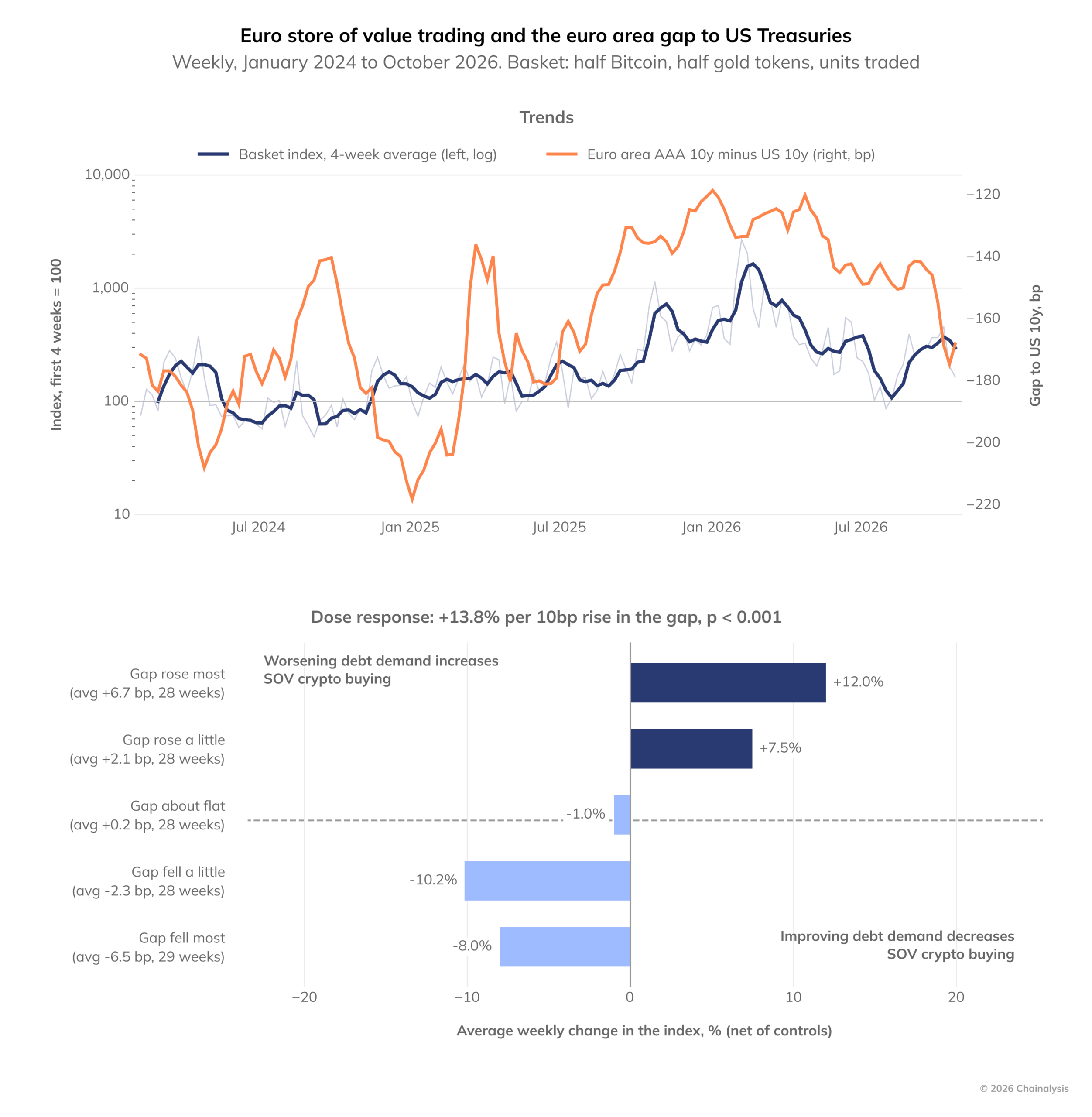
The chapter reports a pattern and says it has not proved a mechanism. When yields on higher-rated euro-area government bonds rose relative to US Treasuries, the share of euro-denominated trading in bitcoin and tokenized gold rose as well. When the spread narrowed, euro trading cooled. On weekly data from July 2025 through June 2026, an increase of about 2 basis points in euro yields relative to Treasuries lined up with euro-priced trading about 7.5 percent higher than dollar-priced trading; about 7 basis points lined up with about 12 percent higher. When euro yields fell relative to Treasuries, euro trading ran about 8 to 10 percent lower.
The backdrop it describes is rising concern about European public finances after years of high debt, successive economic shocks, and weak growth. France is the focus it names: high debt and a political deadlock disturbing the bond market. In October 2026 the French 10-year yield broke 5.14 percent, a 20-year high, which the compilation reads as investor worry about France’s finances and politics. One interpretation it offers is that, when the euro area’s fiscal outlook is in question, traders place bitcoin and tokenized gold in portfolios as alternative hedges. It says the French figures are consistent with that pattern from the side, and it says the data show correlation only. They do not prove direct cause. They also do not show who custodied, margined, or owed these trades.
Prediction-market stakes, collected before a ban
The compilation also looks at European wallets in geopolitical event contracts. It says the cut was taken before the European Securities and Markets Authority’s July 2026 rules, which treat such contracts as retail binary options and largely prohibit prediction markets across the EU. The UK has a related ban. The chapter says the analysis already factors in that shifting regulatory setting.
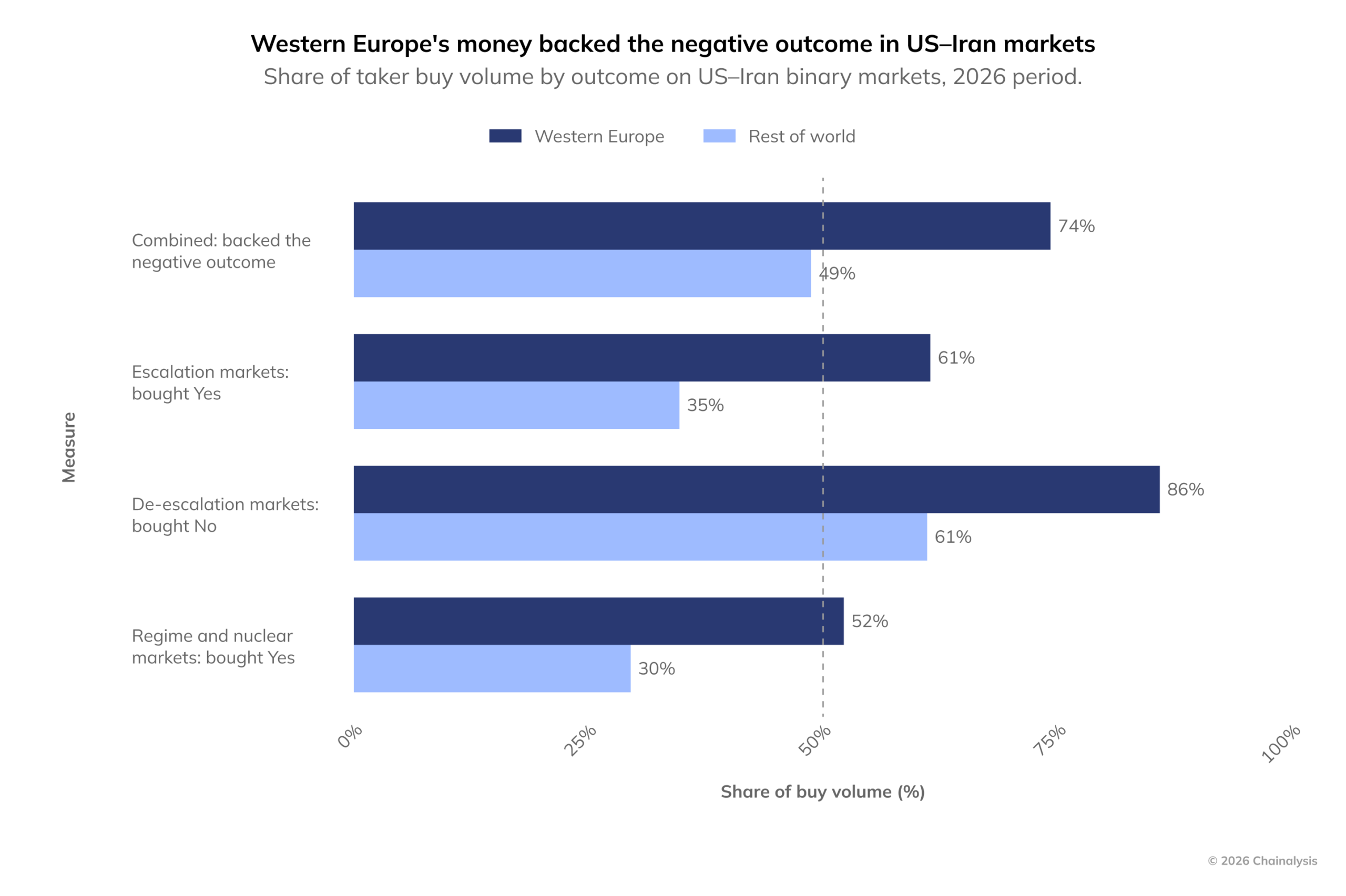
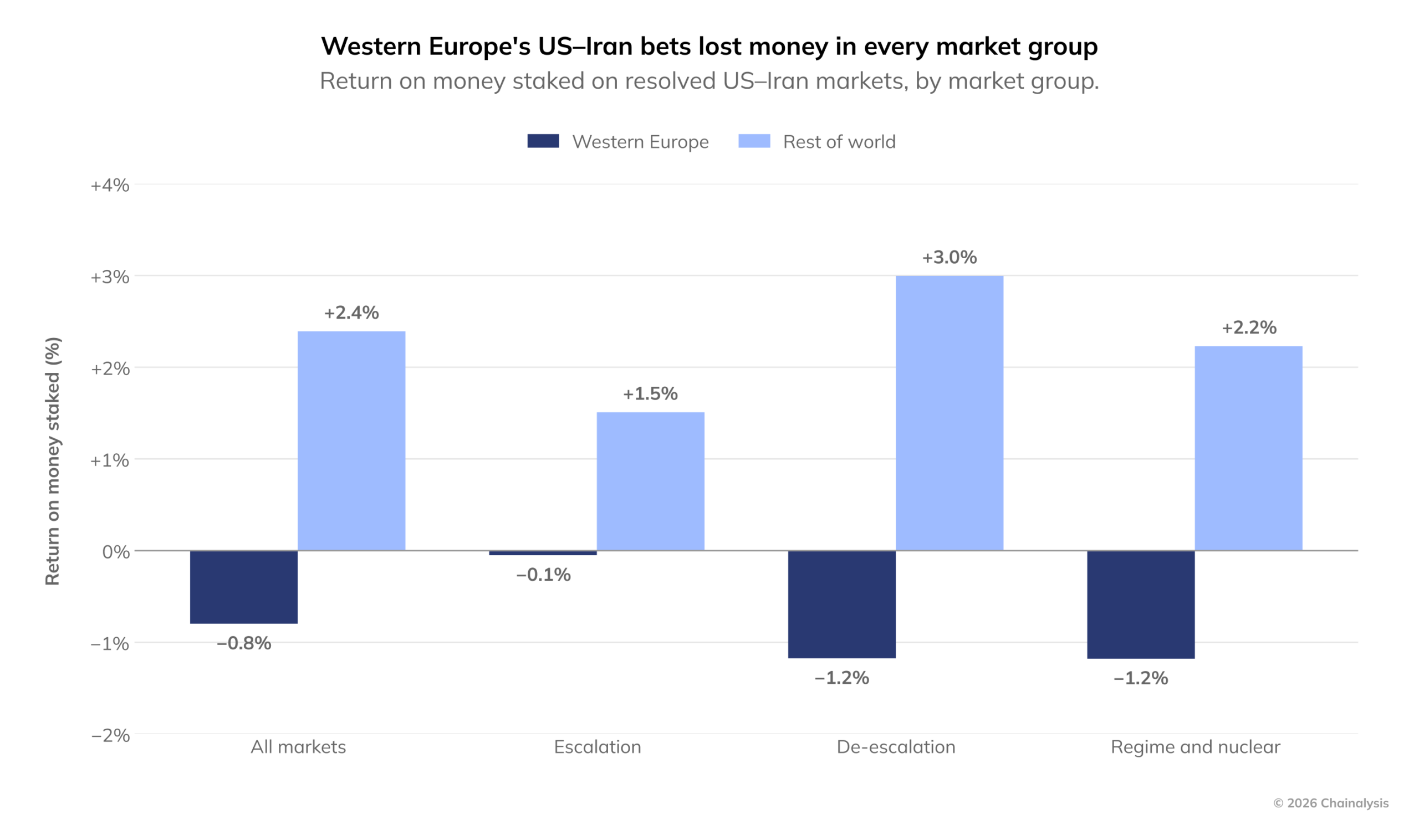
In the window, 74 percent of funds from European wallets in US–Iran binary prediction markets were on negative outcomes, against a global average of 49 percent. On average, negative positions returned worse than positive ones. A chart note says Western European funds lost money in every category of those US–Iran markets. The report’s reading is that these markets were not only a forecasting tool but also a channel for a geopolitical view, and that the direction of the stakes and the profit outcome came apart. That is the betting result Chainalysis reports. It is not a custody product and not a reserve disclosure.
The UK shrank. MiCA’s timing is a clue, not a proven cause.
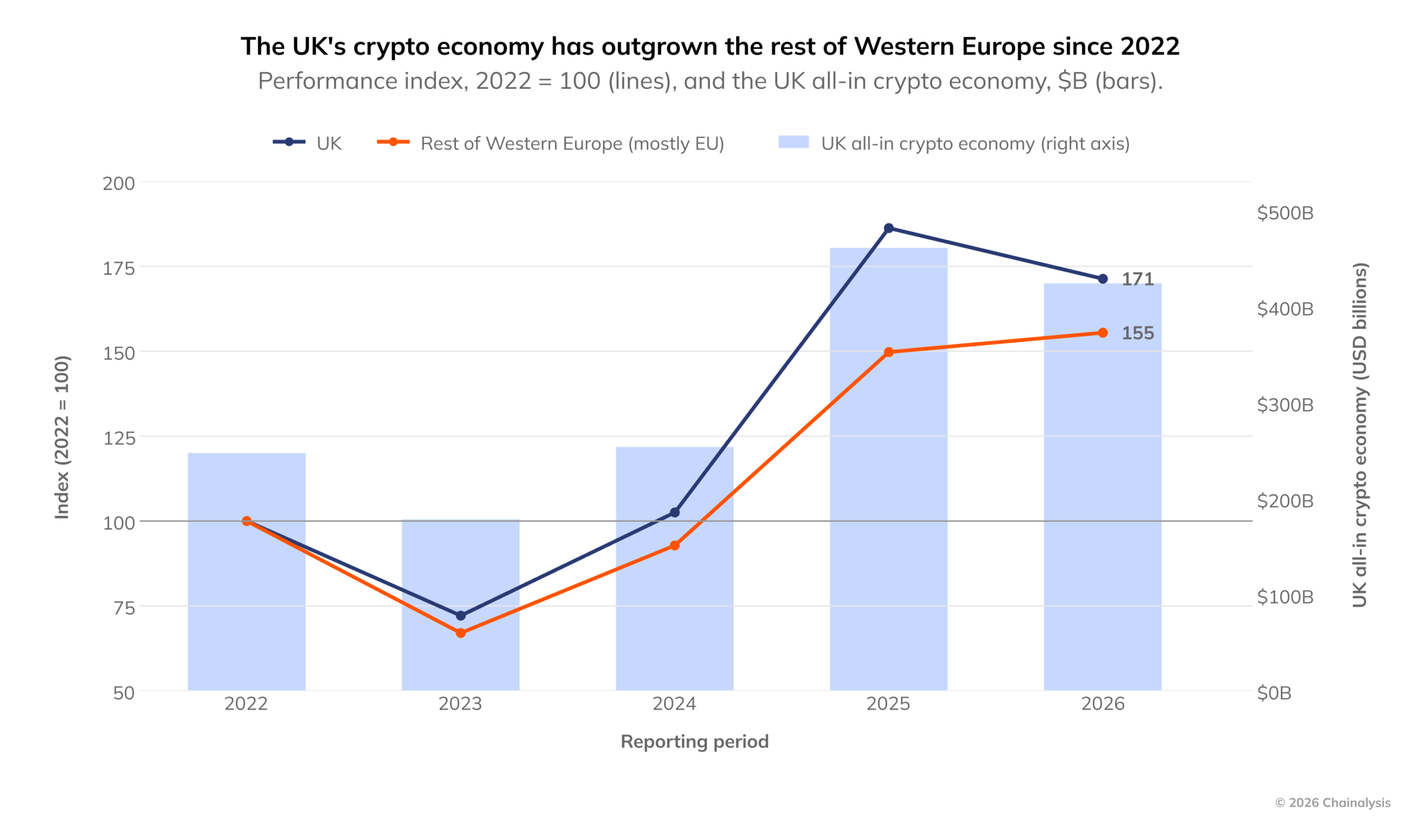
For several years before this window, the compilation says, UK crypto-economy growth led the rest of Western Europe. A chart is described as showing that lead from 2022 onward. Inside July 2025–June 2026 the level reversed: the UK was still the largest market but down 8 percent, the rest of Western Europe grew 3.8 percent, and the EU on its own grew 2.2 percent.
The chapter’s main clue is MiCA’s sequence. Early application from December 2024 raised compliance costs and left rules uncertain, which it says held growth back in the short run. After service providers completed the transition and held licenses in July 2026, the same regime is described as a tailwind, because a licensed provider could operate in every EU country without a new license in each. That expansion, it says, happened while global crypto market capitalization halved. The UK had no equivalent single statute against the downturn. The compilation also ties the cooling to the Financial Conduct Authority opening a crypto regulatory permissions gateway in September — the month is given as September, placed after the July 2026 licensing point, without the year repeated on that clause — and says many participants waited.
It then states the limit: the data cannot show that regulation was the entire cause, market factors are intertwined, and MiCA’s effect cannot be separated out. The dates line up closely. That is as far as the chapter goes. A license changes who may offer a service and in which countries. These figures do not identify client liabilities or the assets held against them.
In the UK, stablecoins shifted toward domestic balances
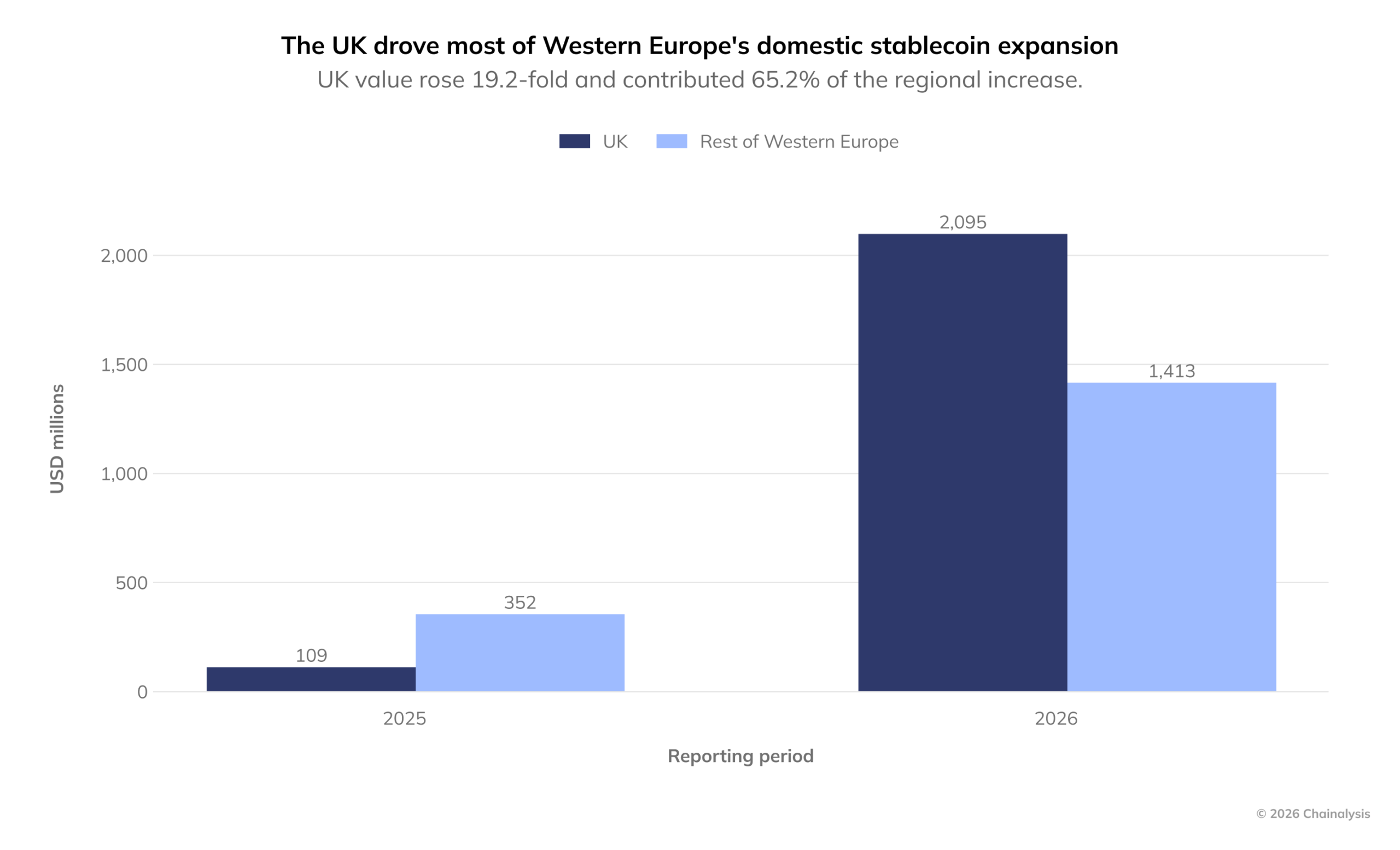
The compilation says stablecoin use inside the UK changed: no longer only a cross-border remittance tool, with domestic circulation rising quickly. Domestic wallet-to-wallet stablecoin transfers reached $2.09 billion in the window, from $109 million in the prior-year period. The UK’s increase in domestic stablecoins accounted for 65.2 percent of Western Europe’s total increase, and its transaction value accounted for 60 percent of the region’s domestic transfers. UK domestic transfer value was 1.32 times its cross-border peer-to-peer and service-provider transfers. In the rest of Western Europe, cross-border volume was 4.38 times domestic volume.
In June 2026 the Bank of England published a draft policy for systemic stablecoin payments. It also set a personal holding limit: for any single systemic sterling stablecoin, one person may hold at most £20,000. The compilation says that limit will shape the role stablecoins can play in household finances, and that on-chain data were already showing more ordinary UK users treating stablecoins as a place to park funds, not only as a chip between trades. A draft cap is a limit on how large a holding may be. It is not a finding that balances sat under the cap, that a sterling stablecoin’s reserves matched claims, or that a holder had a claim on the Bank of England.
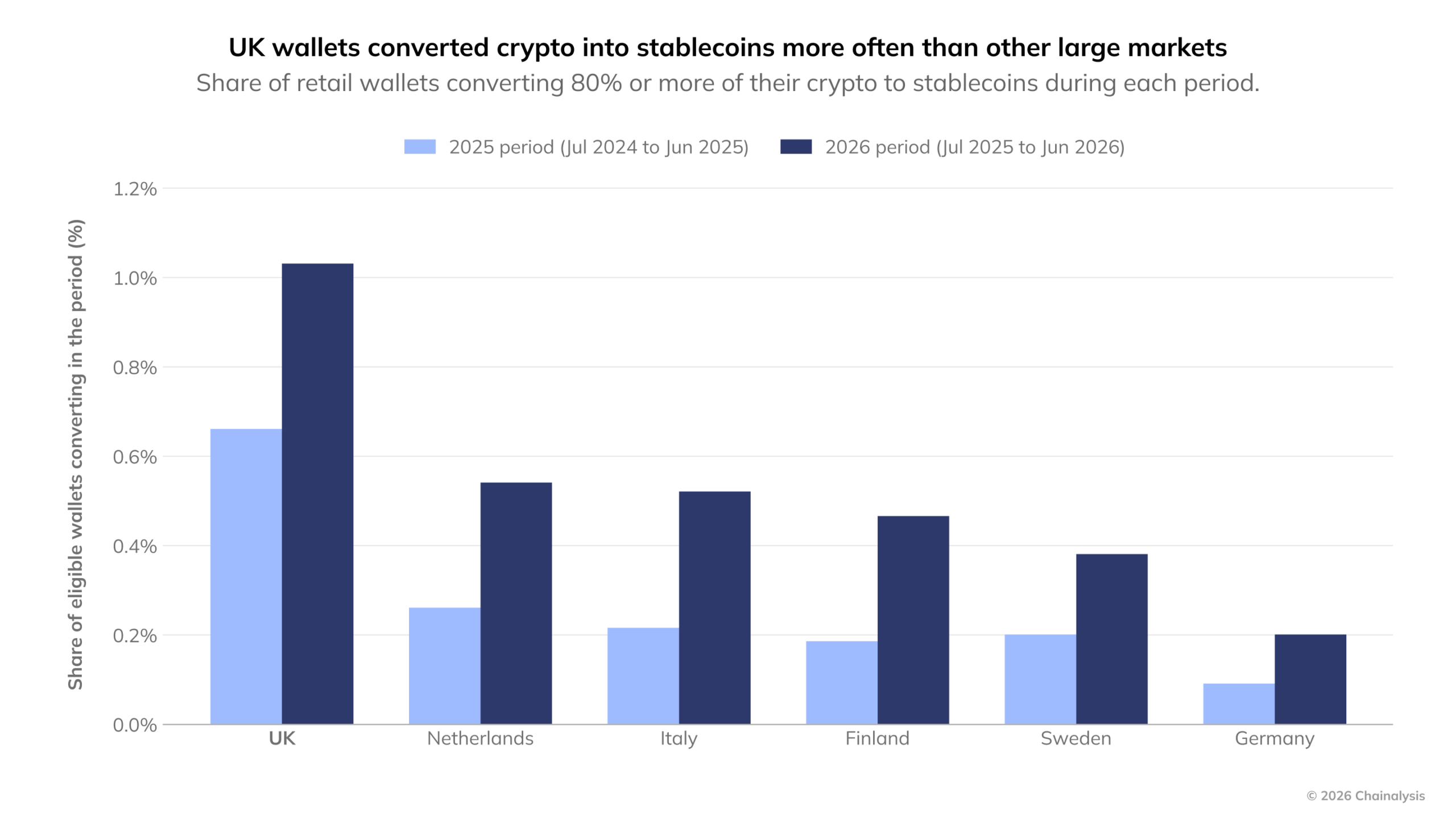
Among eligible retail wallets, 1.03 percent in the UK had converted at least 80 percent of crypto assets into stablecoins, up from 0.66 percent a year earlier and the highest share among six core markets in this comparison: the Netherlands 0.54 percent, Italy 0.52 percent, Finland 0.46 percent, Sweden 0.38 percent, and Germany 0.20 percent. All six shares rose. Italy’s was 2.5 times its prior level, Germany’s 2.3 times, and the UK’s 1.6 times, so Italy and Germany rose faster as multiples while the UK’s lead in the level still widened. The chart’s phrase — retail wallets that moved the great majority of their crypto into stablecoins — describes this thin slice, not most UK retail wallets.
The conversion wave peaked in July through September 2025, before Bitcoin’s October 2025 high. The chapter treats that order as a sign the shift was not only bear-market hedging but a slower change in habit. Following those wallets, the team found that when prices later fell, many of those users kept holding stablecoins. “Many” is not given as a percentage.
France: more self-custodied stablecoins, still an issuer’s liability
The compilation presents France as the focus of Europe’s fiscal strain: high debt, a split parliament, difficulty cutting spending and the deficit, protests against austerity, budget bills that repeatedly struggled to pass, and weaker confidence in French public finances. Against that, it reports three on-chain signals that French users were managing assets in self-custodied stablecoins: a rising share of exchange withdrawals made in stablecoins, more personal wallets holding them, and growing balances. The stated motive is that users wanted to control the assets themselves.
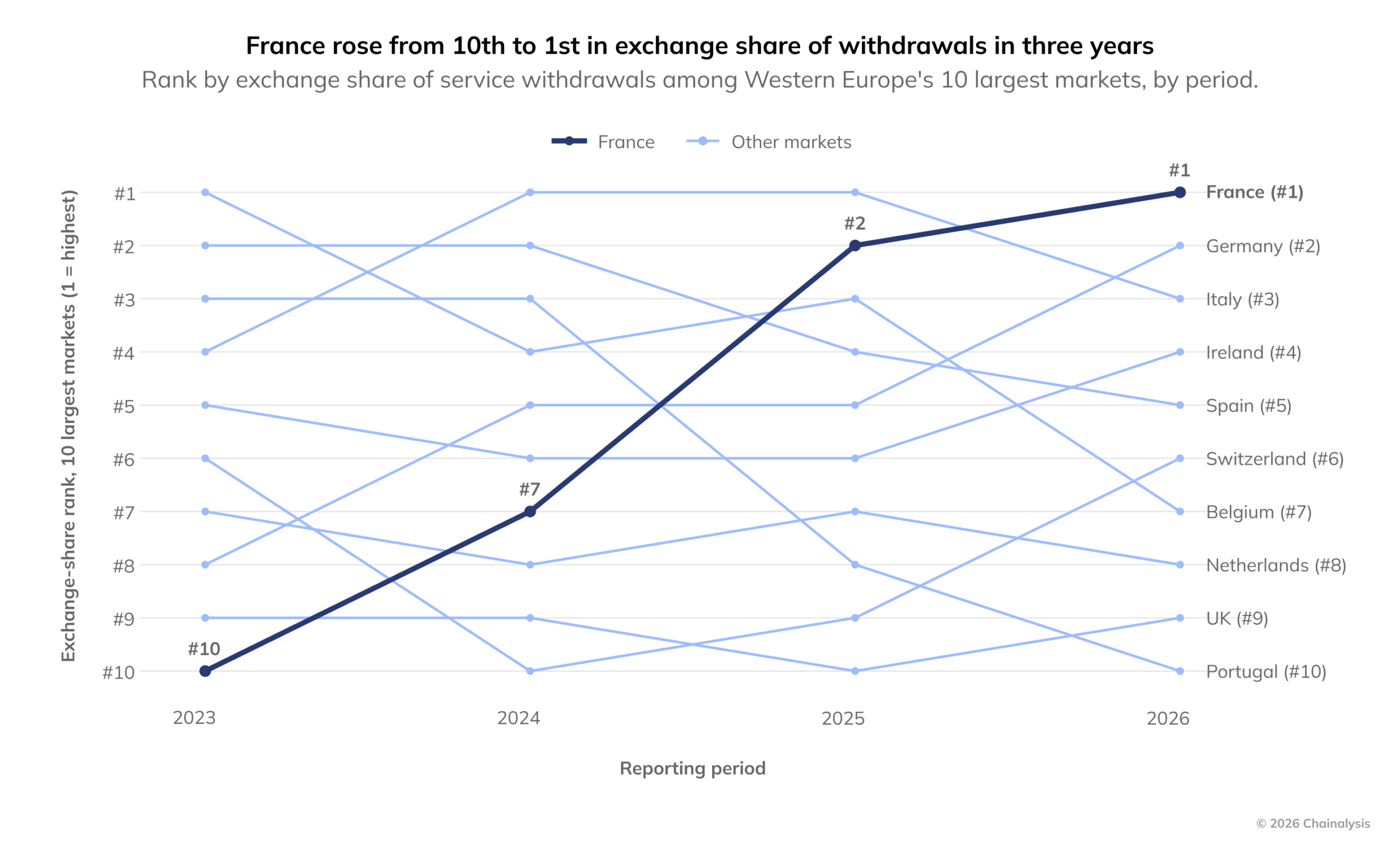
Over three years France moved from 10th to 1st among major Western European markets by the stablecoin share of exchange withdrawals. In the window, stablecoin withdrawals were 54.2 percent of what French users took off exchanges, ahead of Germany. The total sent from exchanges to French wallets rose 12 percent, against a 7 percent average for the rest of Western Europe.
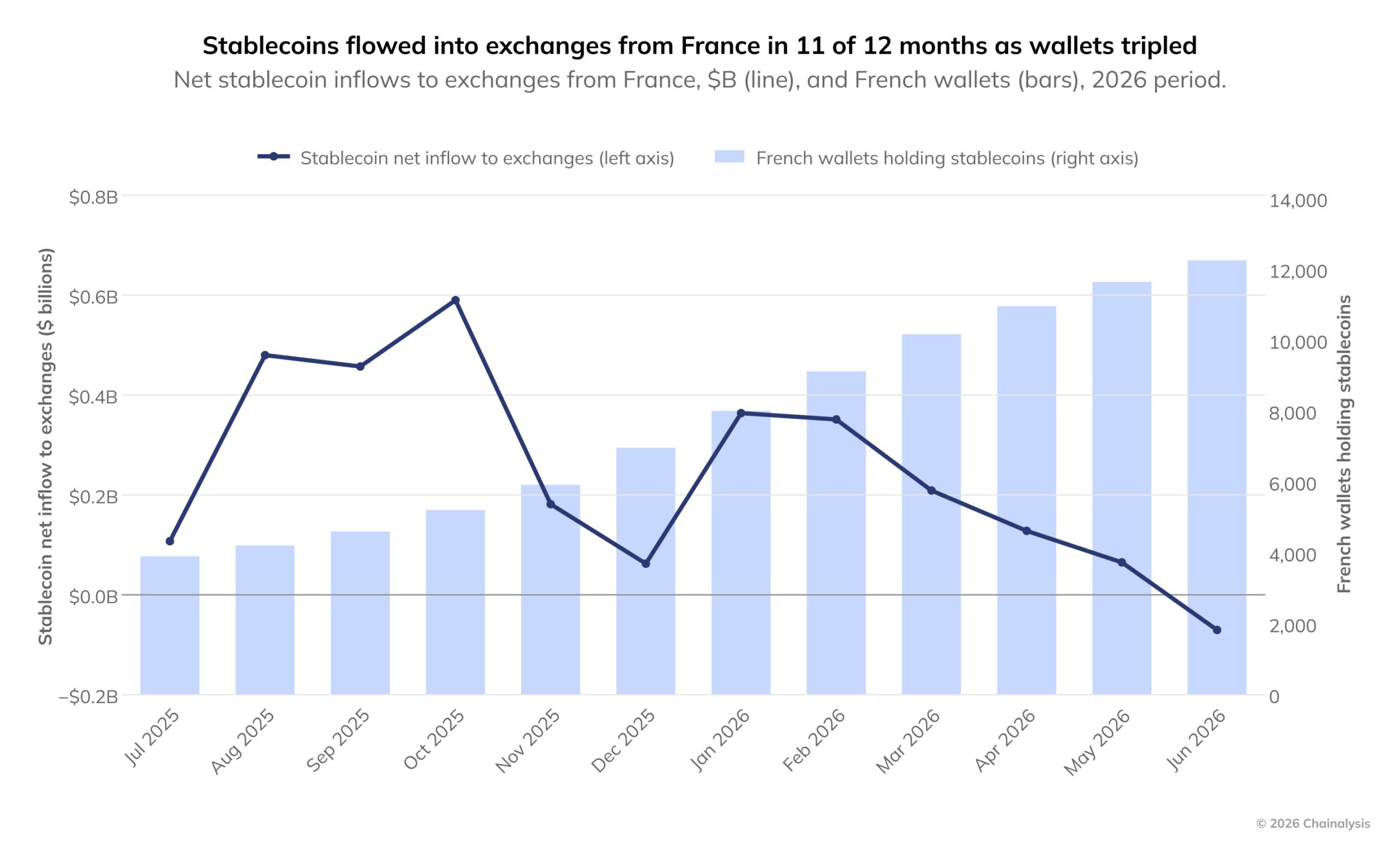
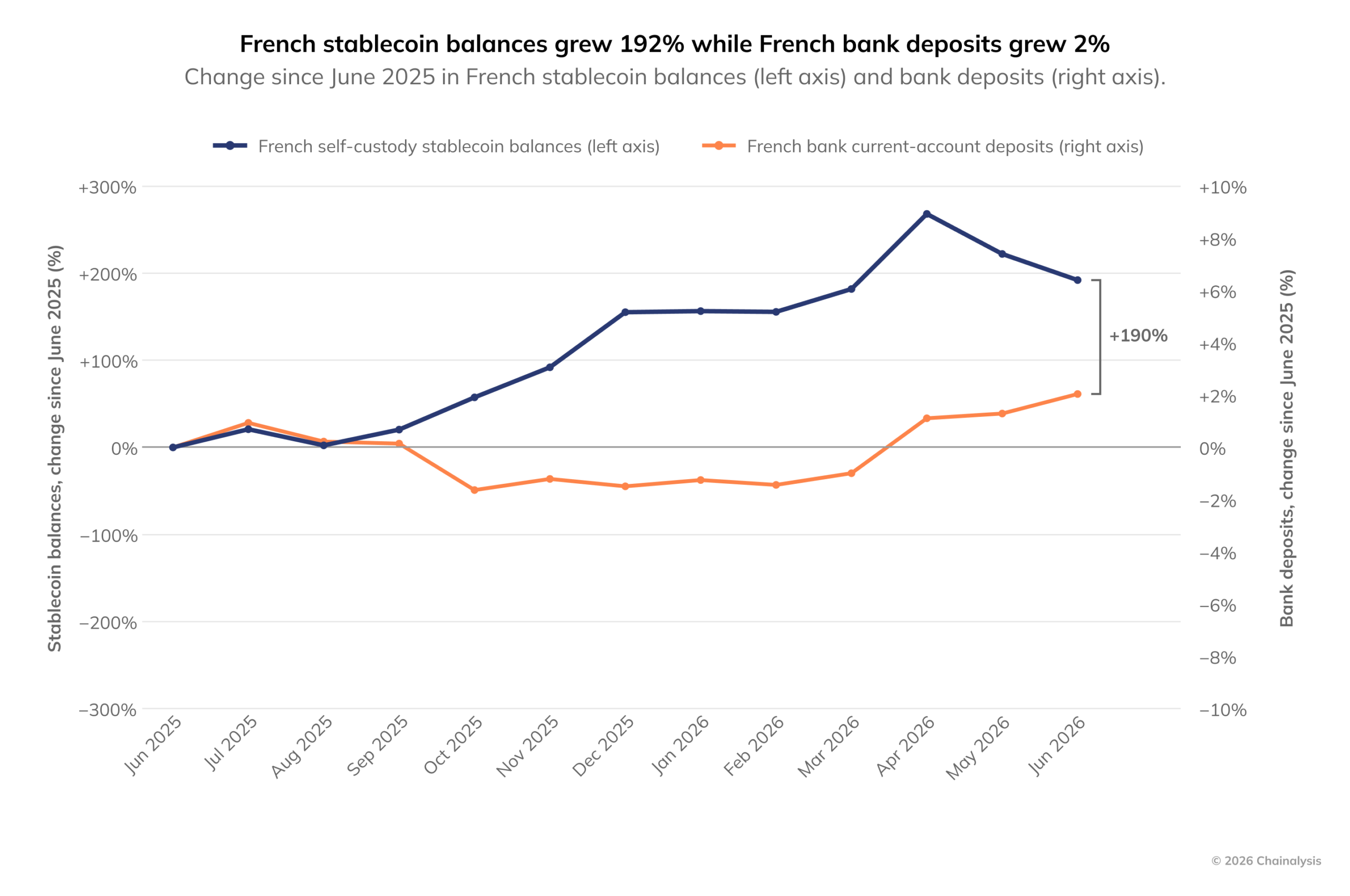
French personal wallets holding stablecoins went from 3,577 in June 2025 to 12,255 in June 2026, 3.4 times, against an average of 1.7 times elsewhere in Western Europe. The chapter says the pace moved with the bond market: monthly growth near 6 percent around mid-2025, a single-month pace of 18 percent by year-end after autumn bond-market turmoil, then back to 5 percent by June 2026. The report’s statistics stop in June. It says a further round of bond-market stress in October is outside the sample, so any later pass-through is not visible. A figure note in the compilation says stablecoins recorded net inflows to exchanges in 11 of 12 months, reported alongside the rise in withdrawals into self-custody rather than folded into one net number.
Self-custodied stablecoin balances tied to France rose 192 percent in the window. French bank deposits rose 2 percent over the same span. The compilation says the stablecoin stock is still very small next to traditional savings, and that the growth gap is what stands out. Its interpretation is that residents were looking for another place to hold assets under uncertainty — not that they had lost confidence in the euro, and closer to diversification than to a rejection of the currency.
Self-custody changes who holds the keys. It does not change who issues the stablecoin. The on-chain balance is not a French bank deposit, and the 192 percent increase is not evidence that an issuer’s reserves covered redemptions, that holders owned the euro assets behind the token, or that the balance would be paid if a bank failed. The compilation does not claim those things. The contrast with a 2 percent rise in bank deposits looks large because, as the chapter says, the stablecoin base is still small.
Spain’s exchanges took more from the rest of Europe than from Spain
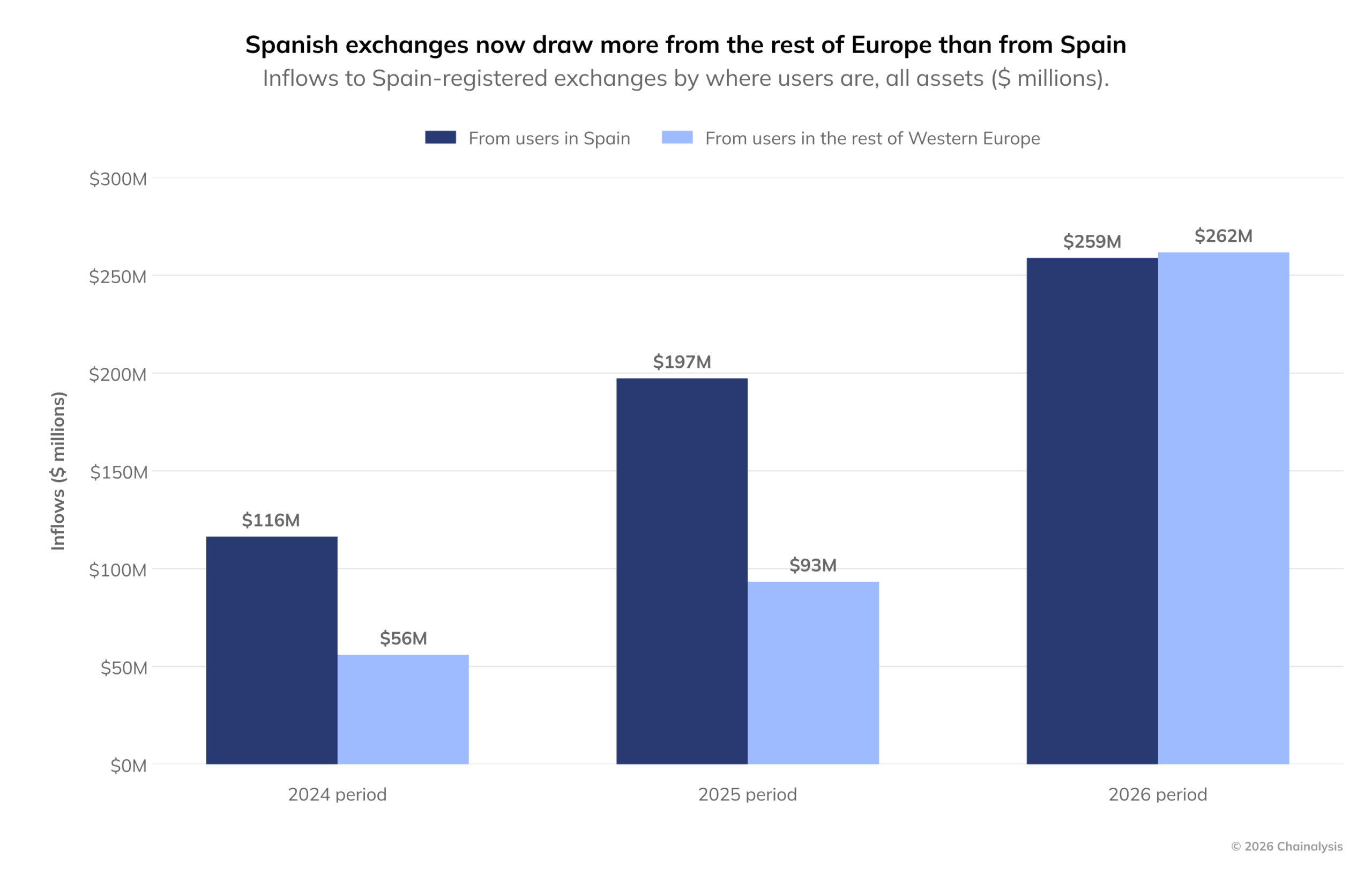
The compilation says inflows to Spanish crypto exchanges were no longer mainly domestic. During the window, users in other European countries sent more than Spanish users did. From 2024, both domestic and cross-border inflows rose, and cross-border inflows rose faster.
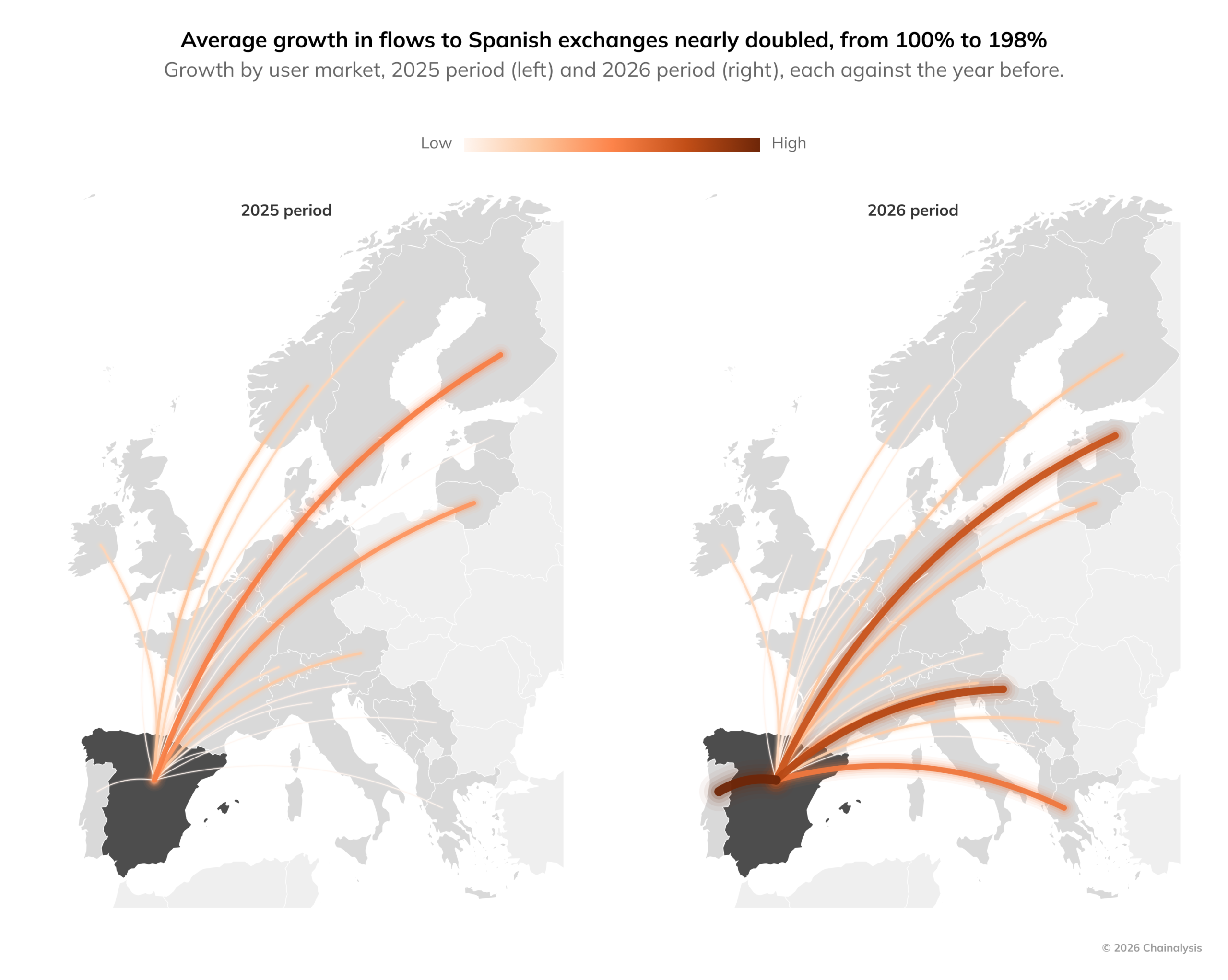
Among countries that had transferred more than $100,000 to Spanish exchanges in the prior year, average growth in the window was 198 percent, compared with 100 percent the year before that; median growth went from 82 percent to 162 percent. Italy and Portugal were the largest sources: Italy’s growth rate went from 22 percent to 329 percent, and Portugal’s from 36 percent to 751 percent. Inflows from other European countries into Spanish exchanges grew 79.1 percent, while Spain’s own crypto economy grew 24.6 percent. From July 2023 through the report’s present, the compilation says Western European users transferred $984 million to Spanish exchanges, of which $521 million arrived in this statistical window.
Gabriel Ayala, API and banking-business director at the Spanish exchange Bit2Me, is quoted on why: some neighbouring countries lack a large domestic platform. Portugal’s market size and language, he said, make a large local platform hard to produce; Italy’s regulation is complex and its market fragmented, so a large domestic exchange is hard to form. In this account, Spanish platforms used compliance and scale to compete across Europe, and MiCA further lowered the barrier to operating across the EU. The flow totals are the reported change. Ayala’s explanation is the firm’s account of why flows concentrated, not a separate measurement of the Portuguese or Italian markets. Funds that sit at an exchange are a claim on that exchange until they are withdrawn. A cross-border inflow shows where users chose to send assets. It does not show segregation, a reserve report, or what the exchange would owe if withdrawals clustered.
The compilation treats the Spanish pattern as one picture of European markets joining up.
What the chapter leaves open
The compilation also summarizes Spangevičius as saying that Europe’s crypto industry had moved from scattered local speculation toward structural maturity. Its closing view is that stablecoin use, cooler DEX trading in some markets, exchanges drawing users across borders, changing habits, and macro conditions were reshaping Western Europe together, and that Europe is a clear sample of how financial stress, geopolitics, and rule changes alter digital-asset trading. Whether the industry continues, it says, depends both on institutional money keeping coming and on how practitioners adapt to the financial and regulatory setting. With institutions more deeply involved, it names consumer protection, more uniform rules, and the link between crypto markets and the banking system as the issues that will decide the longer path.
Those are the compilers’ questions, as published on 10 November 2026. The window they measure still ends in June 2026. Across the chapter, the stated changes are volumes, shares, wallet counts, and the text of rules and objections. They identify venues and, in places, who is likely to be the counterparty. They do not close the obligation. Wallet balances are not liabilities matched to reserves. A MiCA license is not a solvency finding. A required share of reserves held as bank deposits is not, on this record, proof that the token holder owns those deposits or stands where a depositor stands.
Original article, published 10 November 2026 at 14:15 (UTC+8): Chinese compilation by Luffy, Foresight News, of Chainalysis’s 2026 Global Crypto Adoption Report, Western Europe chapter, on TechFlow Post — https://www.techflowpost.com/zh-CN/article/35251.