
In testing reported on November 17, 2026, Juicebox developers found that some payment-contract transactions on Ethereum’s Sepolia testnet could succeed even when an internal payment failed. The behavior appeared under proposed Glamsterdam upgrade rules; it was not reported as a change already active on Ethereum mainnet.
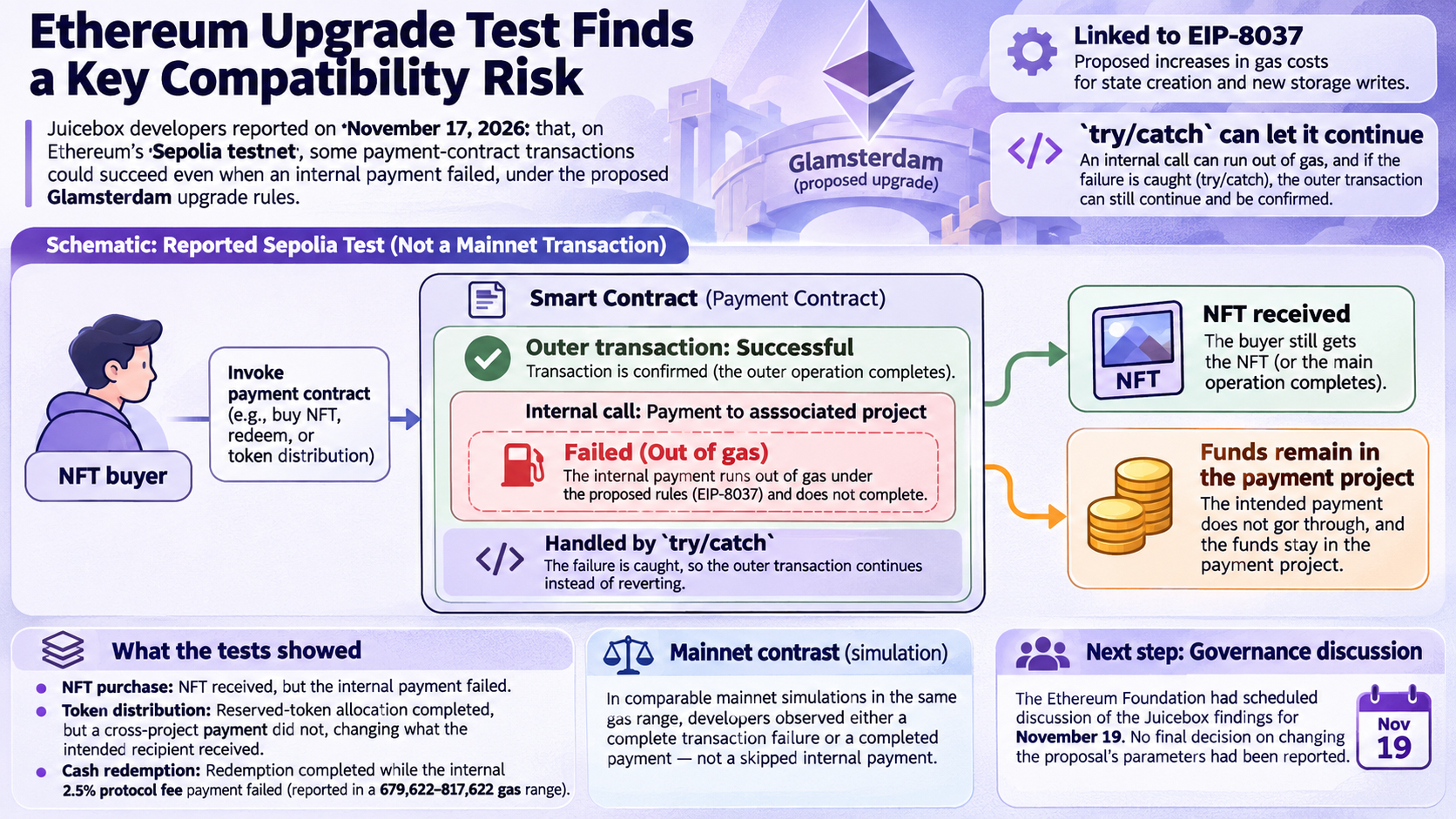
A successful transaction did not guarantee payment
According to Juicebox’s tests, an NFT buyer could receive the NFT while an out-of-gas internal payment to an associated project failed, leaving the unpaid funds in the payment project. In a token-distribution test, a reserved-token allocation completed but a cross-project payment did not, changing what the intended recipient received. A cash-redemption test found that, within a reported 679,622–817,622 gas range, redemption completed while an internal 2.5% protocol fee payment failed.
Juicebox developer mejango linked the behavior to proposed EIP-8037 increases in gas costs for state creation and new storage writes. An internal call could run out of gas before the outer transaction did. Where a contract’s try/catch handling contained that failure, the outer transaction could continue and be confirmed. The developers said comparable mainnet simulations in the same gas range showed either a complete transaction failure or a completed payment—not a skipped internal payment.
For anyone relying on the contract’s payment flow, the distinction is between transaction confirmation and the obligations actually settled. The tests show a potential compatibility risk for existing contracts under the proposed rules, not that every deployed contract is affected. As reported on November 17, the Ethereum Foundation had scheduled discussion of the Juicebox findings for November 19; no final decision on changing the proposal’s parameters had been reported.