Original reporting: November 10, 2026, 18:00 UTC+08:00. The platform described below was still awaiting regulatory approval at that time.
The New York Stock Exchange’s planned round-the-clock tokenized-stock platform would use Avalanche technology for settlement, according to November 9 reporting by The Wall Street Journal, an Ava Labs announcement and NYSE information cited in the original Foresight News report. The platform was targeting a fourth-quarter launch, subject to regulatory approval.
How trading and settlement would work
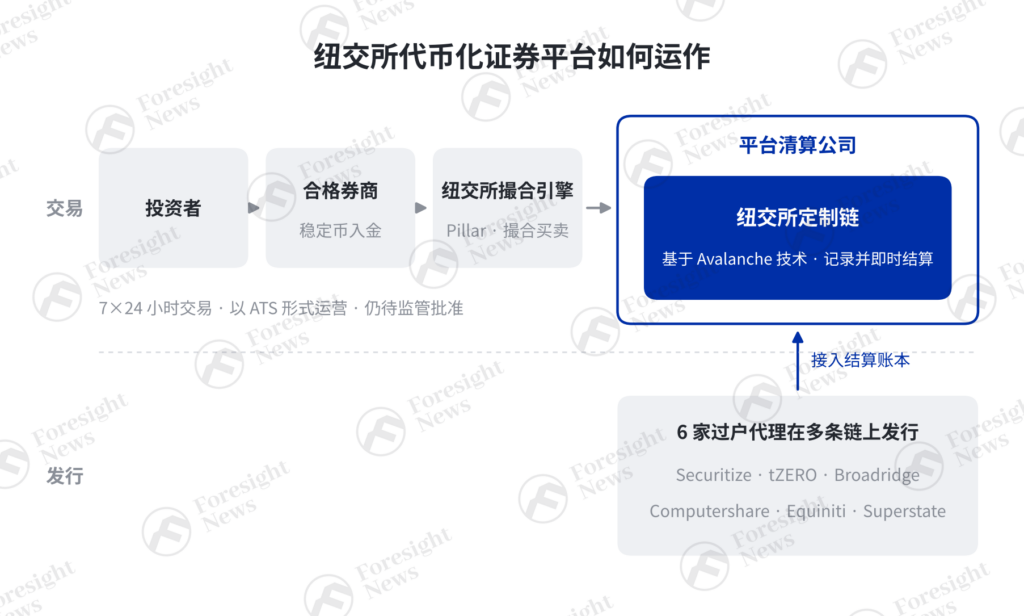
Under the disclosed plan, NYSE’s existing Pillar engine would match trades. The platform’s clearing company would then record and settle them on an Avalanche-based ledger. Investors would be able to fund accounts with stablecoins. Ava Labs chief business officer John Nahas said settlement would not take place on Avalanche’s public chain: NYSE would operate a blockchain customized for regulatory requirements.
The issuance and settlement roles are distinct. NYSE had named six transfer-agent partners by November 2: Securitize, tZERO, Broadridge, Computershare, Equiniti and Superstate. The proposed platform would accommodate tokens issued either by a custodian or by an issuer. According to the reported plan, both types would be interchangeable with traditional shares and carry the same dividend and voting rights. Stocks could be issued on multiple chains, while trading records and settlement would be brought onto the platform’s ledger.
That arrangement makes the identities and obligations of issuers, custodians, transfer agents and the clearing company important; a shared ledger alone does not establish who holds customer assets or who is responsible for a claim. NYSE digital-issuance head Dennis Lee said the settlement ledger needed speed, reliability, controlled participation and predictable costs. The original report describes the proposed chain as an Avalanche L1 with its own validator set, which can be permissioned, rather than the open-access C-Chain.
What the plan does—and does not—mean for AVAX
Neither the Ava Labs announcement nor NYSE’s statement specified a role for AVAX in settlement, transaction fees or staking, the original report said. Under the described L1 model, validators instead pay a recurring AVAX-denominated fee. Avalanche documentation put it at approximately 1.33 AVAX per validator per month when there are fewer than 10,000 L1 validators; those tokens are burned. The fee does not rise with the number or value of settlements, and an L1 operator can choose another token for fees within its chain.
The Avalanche Foundation had separately identified the gap between ecosystem activity and AVAX value capture as a research problem. Its August 12 estimate put cumulative C-Chain fee burns since early 2024 at about $23.5 million, excluding L1 validator fees. L1 revenue sharing and other changes remained research proposals, not enacted mechanisms. On the rules described in the original report, settlement activity on NYSE’s proposed chain would not itself generate AVAX-linked revenue beyond validator fees.
The distinction is consequential: the reported decision concerns infrastructure for a proposed securities platform, not a commitment to settle trades in AVAX or evidence that the platform had begun operating.
Source: odaily.news (originally published 2026-11-10 18:00 UTC+8)